


Summary
- The limitation of pure automation: While AI offers 24/7 speed and handles routine tasks at scale, it lacks the empathy, ethical judgment, and nuance required for complex or sensitive customer situations.
- The AI-powered agent: Instead of replacing humans, AI acts as a strategic assistant that summarizes chat histories, suggests resources, and provides sentiment insights to help agents work faster and smarter.
- The Human-AI Hybrid Model: The most effective customer service combines AI’s mechanical accuracy with human intention, transforming support from simple problem-solving into long-term, trust-based relationship building.
Artificial Intelligence (AI) is transforming the way companies interact with customers, offering speed, automation, and 24/7 availability. However, when used without balance or oversight, AI can also harm customer service quality.
While AI is efficient at handling routine requests, it lacks the human empathy, adaptability, and emotional understanding that customers often expect, especially in complex or sensitive situations.
This article explores how AI strengthens customer service when used wisely, where human judgment remains essential, and why a hybrid approach creates the best of both worlds.
Where AI Elevates Customer Service
1. Speed and Consistency at Scale
AI excels at repetitive, high-volume tasks, such as password resets, order status checks, and frequently asked questions.
This frees support teams from time-consuming, low-impact work, giving them space to focus on what really matters: complex problems, human connection, and strategic improvements.
Customers benefit too: faster replies, 24/7 availability, and consistent service quality regardless of time or channel.
2. Smarter Insights for Better Experiences
AI can do more than handle straightforward queries. By reviewing trends in multiple interactions, it can recognise repeating customer concerns, highlight who might be at risk of leaving, and suggest improvements in advance.
This kind of precise information allows service teams to improve journeys and deal with challenges without delay.
It’s also important to stress that AI does not replace support agents. Instead, it works alongside them, turning everyday data into practical guidance before issues escalate.
3. Empowering Human Agents
With the right approach, AI supports agents instead of standing between them and the customer. It can condense entire chat histories, suggest helpful resources, or show how a customer feels during the interaction.
This extra context allows agents to reply faster and build stronger interactions, moving service from problem-solving to relationship-building.
Where AI Still Needs Human Oversight
1. Emotion, Context, and Care
AI can imitate empathy in tone, yet it cannot replace real emotional understanding. Chatbots especially struggle when slang, sarcasm, or typos are involved. A misread message can cause an inappropriate or incorrect response, damaging the trust and flow of the conversation.
In moments of frustration or vulnerability — whether a payment issue or a personal concern — customers prefer to rely on a human agent who can genuinely hear them and offer comfort.
Although technology may open the interaction, it’s humans who bring it to a meaningful close.
2. Complex and Unexpected Cases
AI is very good at following rules and patterns. It analyses data, applies logic, and gives answers based on what it has learned. But it cannot fully understand the subtileties of human situations.
Humans, on the other hand, can interpret nuance. They can read between the lines, understand when someone is upset even if they don’t say it directly, and make decisions based not only on logic but also on empathy, fairness, and ethics.
AI and humans together work better than AI alone. This balance makes digital interactions smoother, avoids misunderstandings, and helps people feel understood rather than treated like a number.
3. Transparency and Trust
People should always know whether they are talking to a bot or a human. If a company hides this or switches between AI and humans without telling the customer, it can create confusion and damage trust.
But when a company is open about how AI is used — and makes sure the system protects privacy, keeps data safe, and follows ethical rules — then technology becomes something customers can rely on instead of fear.
A Better Way Forward: The Human–AI Hybrid Model
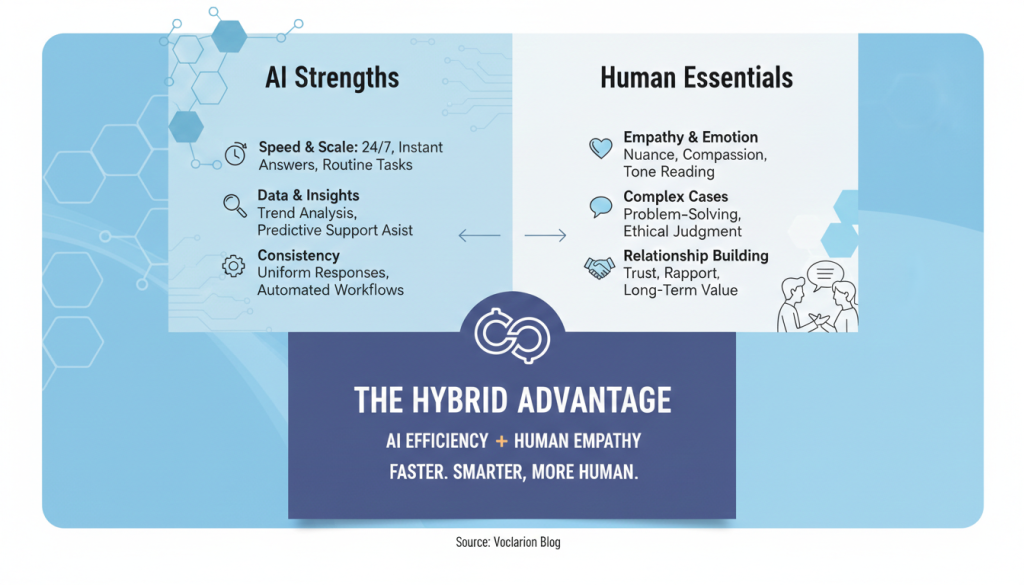
The best customer service happens when humans and AI work together, not when one tries to replace the other.
- AI is great at the mechanical tasks: replying fast, handling many conversations at the same time, and analysing huge amounts of data.
- Humans are great at the emotional and complex tasks: understanding feelings, thinking creatively, and making fair decisions in messy or sensitive situations.
When a company combines both, they get service that is quick, accurate, and personal. This balance improves efficiency while keeping the service human-centred and trustworthy.
AI Speed with Human Heart: The Evolution of Customer Support
AI doesn’t remove the need for human customer service; it actually makes it better. When AI is used in a smart, thoughtful way, it handles routine tasks and provides quick answers. That frees human agents to focus on what truly matters: the complicated questions, the emotional cases, and the moments where empathy is essential.
The idea is that AI brings accuracy and speed, while humans bring meaning and intention. When both work together, customer service improves in every direction: it’s not only quicker, but also kinder, more helpful, and more human.
Empower Your Team with AI-Driven Insights
Our CallCenter platform handles routine tasks automatically, reducing after-call work and allowing your agents to focus on resolving complex cases and building customer trust.