


Voclarion Labs Insight
At Voclarion, we do not just talk about the future of communication. We build it.
Welcome to Voclarion Labs, our internal research division. This is where we test the newest technological advancements ourselves and push the limits of what is possible.
By experimenting with cutting-edge tools firsthand, we figure out exactly what works in the real world before bringing it to our clients.
In this article, we share our latest findings on how Artificial Intelligence (AI) voice agents are completely changing customer care.
Introduction: The New Standard for Client Interaction
The way businesses communicate with clients for service appointments is full of friction. For years, customers have accepted that scheduling a maintenance visit will interrupt their daily lives. They expect the frustrating dance of missed calls, voicemails, and rigid business hours.
We now have the tools to change this. Enter the next evolution of client interaction: Large Language Model (LLM) voice bots. LLMs are a type of AI designed to understand and generate human language. These bots assist companies with arranging service appointments.
The goal goes beyond simple efficiency. The true objective is driving operational effectiveness by fundamentally improving customer care. Rather than forcing clients to conform to a company’s schedule, AI voice agents adapt to the customer’s life. They call clients at optimal times, including evenings and weekends, ensuring higher chances of reaching them.
“The future of scheduling lies in smart, conversational solutions that do more than manage calendars. They fundamentally elevate the entire end-client experience.”
When the call happens, the AI removes friction. It offers infinite patience while a client checks their calendar, easily handles immediate callbacks, and converses seamlessly in multiple languages. This shift is a critical evolution in customer care.
The Current Landscape: A Cycle of Friction
Companies traditionally manage client appointments by having human agents manually dial numbers. This approach serves the company’s hours rather than the customer’s convenience. Calling during the workday guarantees missed calls and triggers an endless loop of voicemails.
Even when a client answers, the interaction is rarely optimal due to several human-centric friction points:
- Lack of Readiness: People are caught off guard. They do not have their personal calendars open. This leads to scheduling errors or requests to call back later.
- Agent Fatigue: A support team member dialing their fiftieth number of the day can sound exhausted. The client feels rushed.
- Language Barriers: If a customer is not fluent in the local language, an unexpected phone call becomes a stressful ordeal rather than a helpful service.
Ultimately, this outdated method wastes resources and turns routine scheduling into a frustrating chore for everyone involved.
How LLM Voice Bots Work: Speed, Context, and Control
The shift from clunky automated menus to seamless conversational agents requires a specific technical setup. It relies on three major breakthroughs:
- Sub-Second Latency: Modern LLMs process audio and respond in milliseconds. This real-time processing eliminates the awkward lag that makes automated calls feel robotic.
- First-Utterance Accuracy: Advanced AI understands complex, multi-part requests immediately. A client can state their entire problem, preferred date, and contact details in a single breath without navigating a rigid phone menu.
- Strict Guardrails: The agent connects securely to the company’s specific knowledge base. It cannot be distracted or prompted to discuss random, off-topic subjects.
Achieving this requires robust technology. Through strategic partnerships with specialized AI developers, advanced chatbot capabilities integrate directly into enterprise voice solutions. Specialized tools and Application Programming Interfaces (APIs), which allow different software programs to communicate, connect the bot and client databases. This transforms a static database into an active, highly secure scheduling engine.
The Power of AI Voice Scheduling: Driving True Effectiveness
Industry research backs this push for operational effectiveness. According to a recent Gartner report, AI agents are predicted to autonomously resolve 80% of common customer service issues by 2029. As Gartner notes, “Unlike traditional GenAI tools that simply assist users with information, agentic AI will proactively resolve service requests on behalf of customers, marking a new era in customer engagement.”
Additionally, McKinsey & Company’s State of AI global survey highlights massive operational shifts. Their research emphasizes that “the value of AI comes from rewiring how companies run,” noting that customer operations and service are among the primary areas delivering the most financial value from AI adoption.
Automating repetitive tasks creates massive efficiency gains. For example, when a last-minute cancellation occurs, an AI voice bot instantly begins calling clients on a waitlist. This dynamic recovery fills schedule gaps immediately.
“This technology is not designed to replace staff. It is built to elevate their capabilities.”
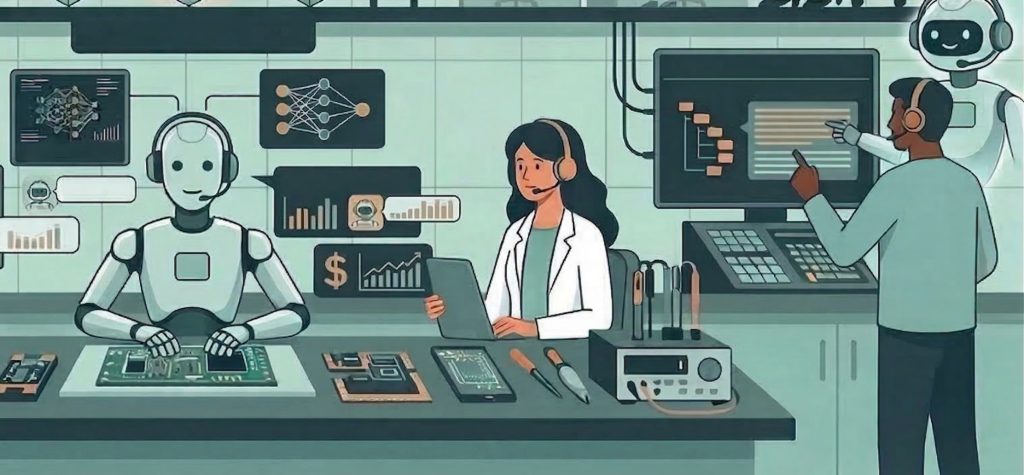
The most powerful setup is a collaborative system where AI and human agents work together. The voice bot handles high-volume administrative tasks. When a client has a complex technical issue or needs deep emotional intelligence, the AI instantly transfers the call to a human expert. The human receives the full context and a real-time text transcript of the AI’s interaction. Human staff are freed from endless dialing to focus entirely on problem-solving.
This technology also breaks down communication barriers through real-time translation. Advanced AI grasps cultural nuances and regional phrasing. A client struggling with the local language can converse comfortably in their native tongue.
Real-World Applications: Transforming Service Industries
The true impact of AI voice scheduling shines in industries like Heating, Ventilation, and Air Conditioning (HVAC), maintenance, and healthcare.
Consider an HVAC or property maintenance company. Seasonal changes trigger massive spikes in service requests. By integrating phone-based AI agents, these businesses handle calls efficiently and at scale.
For example, an AI agent can successfully manage HVAC appointments through automated seasonal outreach. It proactively calls clients to schedule routine tune-ups before peak season hits. When a heatwave or winter freeze strikes, human dispatchers are not bogged down with routine scheduling. They are entirely free to handle emergency repairs. The AI system absorbs the administrative burden, allowing human experts to focus on delivering the physical service.
“Organizations will need to rethink their approach to managing inbound service interactions, preparing for a future where AI-driven requests become the norm.” — Gartner
Navigating the Transition: Challenges and Solutions
Adopting AI voice scheduling introduces legitimate concerns. Business leaders must address voice bot accuracy and data privacy.
Accuracy in voice recognition is a primary focus. Early automated systems struggled with accents or complex phrasing. Modern LLM-powered agents solve this through advanced intent recognition. They process conversational language flawlessly. If a request falls outside the AI’s strict rules, it immediately routes the call to a human expert.
Data privacy is another major hurdle, as scheduling involves personal information. Modern voice solutions use secure, encrypted API connections to communicate with internal databases. This ensures client data remains fully controlled and secure, without ever being used to train public AI models.
Future Outlook: The Road Ahead
The landscape of client interaction is rapidly shifting. The conversational abilities of these systems will only grow more sophisticated. Soon, predictive analytics will allow these agents to anticipate service needs before the client even realizes a maintenance visit is due.
Conclusion: A New Era of Customer Care
The shift away from manual dialing fundamentally improves operational effectiveness. AI voice scheduling is a powerful tool for exceptional customer care, offering massive scalability for businesses with large client bases. The future of service scheduling is not just automated. It is conversational, highly effective, inclusive, and deeply client-centric.
Ready to eliminate scheduling friction and transform your customer experience with AI?
Contact Voclarion today for a personalized demonstration of our AI voice agent solutions. Let’s build the future of your client interaction together.