


Summary
- What is omnichannel customer service? It’s more than offering multiple contact channels – it’s about creating one continuous conversation, no matter the medium.
- An omnichannel approach connects phone, email, chat, social media, and even in-store interactions into one unified experience with consistent tone and context.
- Why is it important? Customers expect speed, coherence, and personalization. Brands that integrate their channels increase customer satisfaction, loyalty, and efficiency.
Omnichannel customer service isn’t just about having a phone line, email, and chat box. It’s about making every interaction feel like one continuous conversation.
What is omnichannel customer support?
In today’s hyper-connected market, the customer journey rarely sticks to a single touchpoint. A shopper might first discover a product on Instagram, then ask a question through a live chat widget on the brand’s website, send an email, and eventually make a phone call to complete the purchase. Omnichannel customer service is the discipline that transforms this fragmented web of interactions into one seamless experience.
Omnichannel support essentially means that every channel – social media, email, chat, SMS, phone, in-store interactions, and even AI-powered self-service – communicates with the same underlying system.
Agents can access the full conversation history, see what the customer has already shared, and continue the dialogue exactly where it left off – no matter which channel is used. The customer experiences a consistent brand identity, avoids repetitive data entry, and feels truly “known” by the company, even when switching between devices.
This unified approach ensures that support is no longer a collection of isolated incidents, but an ongoing relationship. The result: significantly higher satisfaction, loyalty, and revenue, while operational costs are dramatically reduced.
What is an example of omnichannel customer service?
Imagine a customer, Maya, who is excited about a luxury coffee machine. She first sees an Instagram ad and clicks through to the retailer’s website. Curious, she opens the live chat widget, asks about the grinder’s noise level, and quickly receives a reply with a video link.
A day later, she gets an email reminding her that the grinder is back in stock. She clicks the link, adds the product to her cart, and is asked to save her shipping address for future purchases.
When she later calls the support line to confirm her order, the agent can see Maya’s entire interaction history — including the live chat transcript, the email thread, and her cart details — all on one screen. The agent confirms the shipment, offers her a 10% discount on her next purchase, and even schedules a follow-up email with a guide on tuning the machine’s settings.
Throughout the entire journey, Maya experiences one consistent tone of voice, coherent information, and no repetitive questions — a perfect example of true omnichannel service.
The customer-focused definition
The debate on single voice versus multiple voices
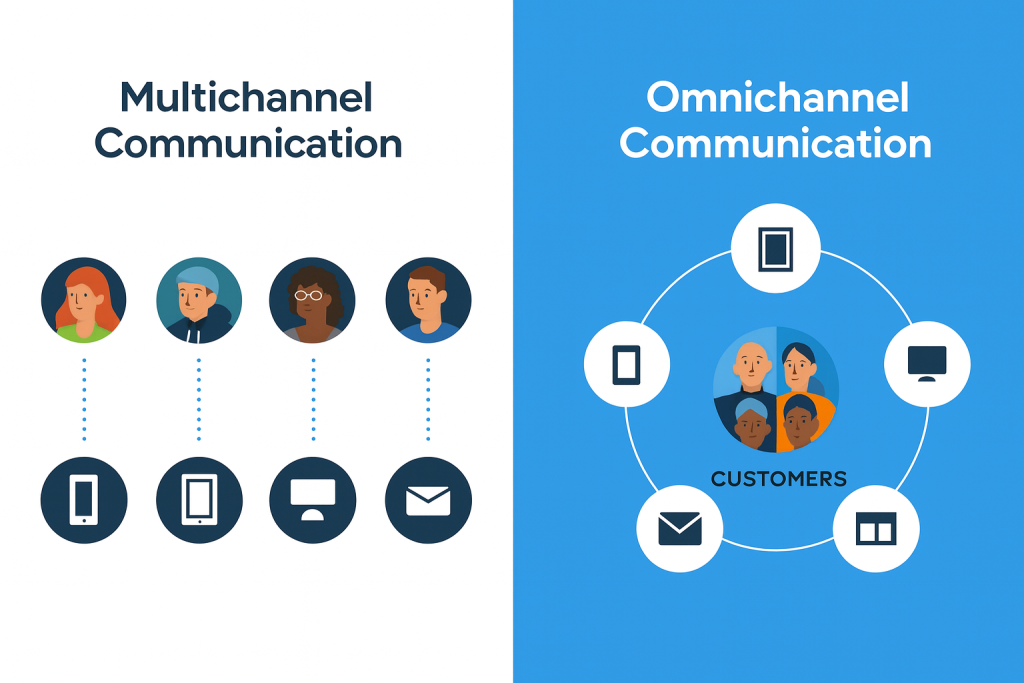
| Multichannel | Omnichannel | |
|---|---|---|
| Voice | Separate brand experience per channel (e.g., “friendly” on social media, “formal” in email) | A unified brand experience that follows the brand across all channels |
| Context | Each channel operates in isolation | Context is shared: a customer who starts in chat can continue the ticket on the phone without re-entering information |
| Customer experience | Fragmented; customer has to repeat information | Seamless; the customer feels “understood,” no matter who or where they are speaking with |
Key takeaway: The shift from multichannel to omnichannel is about consistency, continuity, and context — the three pillars of a frictionless experience.
Outtake: It’s important in 2025 (and beyond)
Customer expectations have changed
- Speed – 82% of consumers expect a response within <2 hours.
- Consistency – 75% expect the same tone, style, and information across all channels.
- Personalization – 63% are more loyal to brands that “remember” them.
- Self-service – 61% prefer to resolve issues online rather than calling.
- Human touch – 59% want a human to handle complex issues, even if AI has assisted in resolving them.
In short: In today’s market, an omnichannel experience is not optional; it’s a differentiator from the competition.
Core Components of an Omnichannel Experience
Digital Channels
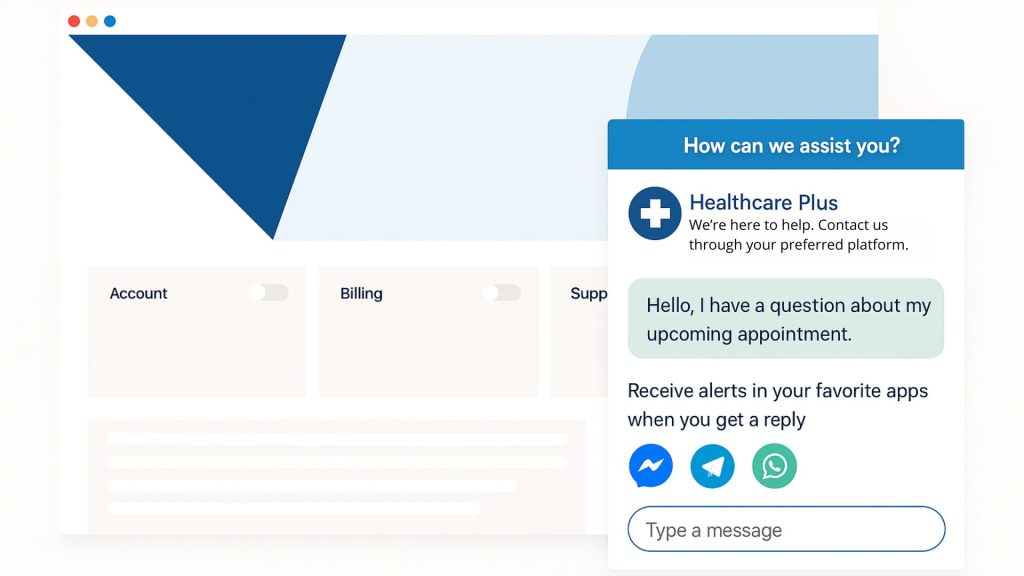
Digital channels form the front door of the omnichannel ecosystem, where the first customer touchpoints occur. From instant messaging to email, each channel offers a unique tone, speed, and level of personalization—but they all must contribute to a single, unified customer view.
By integrating these digital touchpoints, brands ensure that a message sent via live chat, responded to via email, and followed up on via social media all contain the same context, brand identity, and data.
The result is a smooth customer journey where the customer never has to repeat themselves, and service teams can respond accurately, no matter which screen the conversation started on.
Digital channels include:
- Live chat and web chat (first-line, real-time)
- Email (asynchronous, detailed)
- Social media (public and private messaging)
- SMS / RCS (short, immediate)
- Messaging apps (WhatsApp, WeChat, etc.)
Personal and Telephonic Channels
While digital interactions dominate the customer journey, the human touch remains irreplaceable in many scenarios. Personal support, whether in-store, at a kiosk, or at a pop-up event, provides the tangible benefits of face-to-face interaction—employees can read body language, demonstrate products, and build a direct connection. Phone support, meanwhile, offers a voice-driven channel that customers still prefer for complex or sensitive issues, especially when they need real-time guidance or don’t want to type.
To be truly omnichannel, these “offline” touchpoints must be woven into the same data architecture that drives digital channels.
This means:
- Consistent branding: Store staff and call center agents use the same tone, scripts, and knowledge base, ensuring a seamless experience across all media.
- Unified ticketing system: A phone call is logged in the same system that stores the customer’s chat history.
- Real-time visibility: Call center agents can see in-store interactions so they can continue the conversation where it left off.
When personal and telephonic support are integrated, customers benefit from a coherent journey regardless of how they reach out, and employees benefit from full context, reducing duplicated work.
Backoffice Integration – the Engine Behind a Seamless Experience
In an omnichannel world, front-office interactions are just the visible tip of a much larger operation. The real power lies in the invisible back-office systems that process and distribute customer data across every channel.
Backoffice integration is the glue that holds the omnichannel puzzle together: it unifies customer data, knowledge resources, routing logic, and performance metrics so an agent can continue a conversation seamlessly — whether it started via chat, email, or phone — without interruption.
A robust backoffice stack centers on five pillars:
- Customer Relationship Management (CRM): The single source of truth that consolidates all interactions, purchase history, and preferences into one profile.
- Knowledge Base & AI: Centralized, searchable information that empowers both agents and self-service customers, while AI augments the knowledge base with predictive suggestions.
- Intelligent Routing & Workforce Management: Real-time algorithms that assign tickets to the most suitable agent based on skills, context, and capacity, ensuring the right person handles the right issue at the right time.
- Analytics & Feedback Loops: Dashboards displaying KPIs (CSAT, NPS, AHT) and insights for continuous improvement, closing the loop between frontline experience and strategic direction.
- Digital Communication Channels: Unified platforms (chat, email, social media, SMS, voice) that feed interactions into the same ticketing system, ensuring each touchpoint shares a single conversation history and maintains the same context, tone, and routing logic.
When these components communicate via well-designed APIs and shared data models, the backoffice becomes an invisible ally, increasing customer satisfaction, lowering operational costs, and unlocking new revenue opportunities. In short, backoffice integration transforms disparate silos into a synchronized, customer-centric engine that makes the true omnichannel experience possible.
Developing the Right Strategy
Map the Customer Journey
Create a “journey map” that connects all channels.
Steps:
- List all possible touchpoints – Identify every way a customer can reach out (e.g., website chat, social media DM, phone, in-store, email). Record the typical intent and volume for each touchpoint.
- Identify decision points and transfers – Highlight moments where the customer chooses a path (e.g., “I want a refund” triggers a phone queue) and where the conversation shifts between channels or agents.
- Add customer emotions and pain points – Map out how customers feel at each stage (frustration, excitement, uncertainty) and note the friction these emotions create.
- Mark where context should transfer – Indicate which data or actions need to be shared across channels (ticket ID, previous chats, purchase history) so the next touchpoint proceeds seamlessly.
Use a tool like Lucidchart or Miro to keep it visual.
Align your technology stack
To create a seamless omnichannel experience, you first need to identify the systems you already have and their gaps.
Think about your CRM, ticketing platform, knowledge base, and analytics tools. A cohesive stack provides a single source of truth, real-time context, and transparent reporting – all customer-focused.
Voclarion Callto365 is a powerful all-in-one solution for omnichannel communication:
- Complete telephony – International numbers, minutes, a full phone system with IVR, ACD, queues, and call recording.
- CRM integration – All customer data is automatically processed after the call, giving agents immediate access to the full interaction history.
- Microsoft Teams compatibility – Works seamlessly with Teams Calling, adding reporting, call queues, and a native cloud infrastructure.
- Optional: Call analysis – Detailed sentiment analysis of all calls to provide insight into how conversations can be improved based on the tone of the interactions.
- Reporting – Integrates seamlessly with Power BI for detailed reports.
- Cost savings – No expensive add-ons are needed; everything is available at a competitive price.
Demonstration?
Schedule a live demo today and discover how Voclarion Callto365 can transform your organization into a true omnichannel hub.

Real-World Success Story
The Challenge and the Solution: A Customer Case that Makes the Difference
In the complex world of customer service, it’s essential that employees have the right information immediately available. A recent collaboration with a client illustrates this perfectly. This client uses multiple CRM systems, with one system split into several instances serving different branches and geographic regions (countries), each with its own configuration and data structure. This created a situation where an incoming call could place the call center agent in a specific “shop” within a specific geographic location, requiring access to the corresponding CRM data.
The challenge?
Ensuring the correct customer data is available, no matter where the caller is coming from. Specifically, we had to integrate with multiple APIs and databases and implement routing logic to activate the correct CRM system for each incoming call, depending on the caller’s location and branch. This required detailed knowledge of the different systems and their integration points. Our omnichannel communication solution provided the answer. By implementing intelligent algorithms, our software automatically identifies the relevant customer record based on the incoming call and presents it to the call center agent.
The result?
Significantly improved efficiency, less frustration for both employees and customers, and a better, more personalized customer experience. Agents no longer need to manually search for the right information, allowing them to focus on resolving the customer’s question or issue. This case highlights how a well-integrated omnichannel communication solution can transform customer service and increase customer satisfaction, even in the most complex IT environments. It’s a prime example of turning complexity into a simple, effective, and customer-focused workflow.